
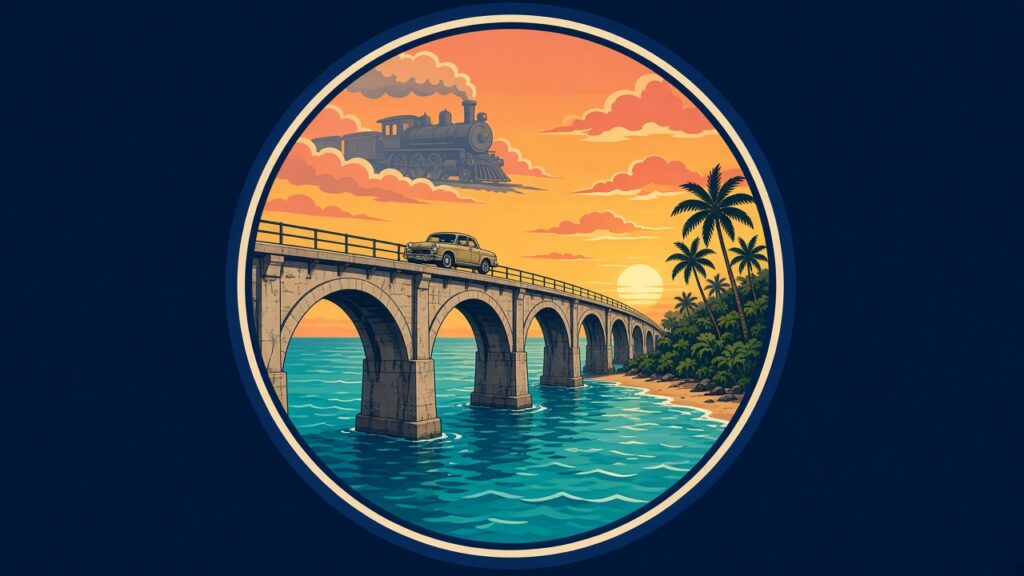
Every day, thousands of cars roll down U.S. 1 from Florida City to Key West, windows down, turquoise water on both sides. Most drivers never realize they’re riding on the bones of a railroad, and that the highway exists today largely because of one of the strongest hurricanes ever to hit the United States, and the World War I veterans who were caught in it.
The “Eighth Wonder of the World”
In the early 1900s, oil-and-railroad tycoon Henry Flagler set out to do what many called impossible: run his Florida East Coast Railway across open water all the way to Key West. The Key West Extension, better known as the Overseas Railroad, was completed in 1912. Crews built long concrete viaducts and bridges island to island across the Keys, and the finished line was hailed as the “Eighth Wonder of the World.”
For more than two decades, the train was the Keys’ lifeline. It carried passengers, mail, and freight, and it connected island towns that had only been reachable by boat.
Veterans Building a Highway
By the 1930s, Florida wanted a road to the Keys too. During the Great Depression, a federal relief program hired hundreds of out-of-work World War I veterans to build sections of an overseas highway. Many came from the Bonus Army, the veterans who had marched on Washington in 1932 to demand the compensation they’d been promised. They lived in simple work camps in the Upper and Middle Keys, including camps on Lower Matecumbe Key, and worked on bridges and roadbed in the tropical heat.
Labor Day, 1935
On September 2, 1935, Labor Day, a compact but ferocious hurricane slammed into the middle Keys. It was the first Category 5 hurricane known to strike the United States, with winds estimated near 200 mph and a storm surge estimated at about 18 feet. It still ranks among the most intense hurricanes ever to make landfall in the U.S.
Officials had ordered a rescue train out of Miami to evacuate the veterans, but because it was a holiday it took hours to assemble a crew and cars. The train left the Miami yard at about 4:25 p.m. On the way, debris blocked the tracks, and at one point a steel cable snagged the train, costing more precious time. It reached Islamorada around 8:15 p.m., just as the surge arrived.
The sea swept the passenger cars right off the tracks. Only the heavy locomotive and its tender stayed upright. Remarkably, everyone aboard the train survived. The veterans in the camps were not so lucky. More than 400 people died in the storm, and the Library of Congress puts the toll at 485 or more, including about 260 veterans. Ernest Hemingway, then living in Key West, wrote a furious essay titled “Who Murdered the Vets?”, and the storm prompted a Congressional investigation.
Near Mile Marker 73, just west of Lower Matecumbe Key, eight concrete bridge piers and a small dredged island now called Veteran’s Key still stand. They’re what remains of the veterans’ own highway work, and a memorial plaque on Craig Key marks the spot.
From Railroad to Roadway
Here’s the twist most people don’t know. The hurricane wrecked long stretches of the railroad in the Upper Keys, and the Florida East Coast Railway couldn’t afford to rebuild. So the State of Florida bought the railroad’s right-of-way and the remaining bridges for $640,000.
Instead of starting from scratch, engineers built the highway on top of the old rail bed. The railroad bridges had come through the storm in good shape, so crews topped them with new two-lane concrete road surfaces for cars. At the Bahia Honda Rail Bridge, which was a steel truss bridge, they built the roadway right on top of the trusses. You can still see that bridge today from Bahia Honda State Park.
The fully connected Overseas Highway opened on March 29, 1938, and became the southernmost stretch of U.S. Route 1. Over the following decades newer bridges replaced the originals. In 1979, the historic Long Key Channel, Knight’s Key (Seven Mile), and Bahia Honda railroad bridges were listed on the National Register of Historic Places. Many old spans now serve as fishing piers, bike paths, and walkways.
Next Time You Drive the Keys
The next time you cross the Seven Mile Bridge or pass the old piers near Mile Marker 73, take a second to picture the steam train, the veterans’ camps, and the night the ocean rose over the islands. The road beneath your tires is a tribute to Flagler’s railroad and to the men who worked and died building a highway to the Keys.
Getting Your Car Down the Overseas Highway Today
Driving the Overseas Highway is one of America’s great road trips. But if you’re a snowbird, a new homeowner, or simply flying in for the season, you may not want to put the miles on your vehicle or spend days on the road. That’s where In-N-Out Keys comes in.
We’re a veteran-owned interstate auto transport carrier and broker serving the entire Florida Keys, from Key Largo to Key West. We offer true door-to-door delivery in the Keys. There’s no meeting a truck in Homestead and no long drive to pick up your car. We bring your vehicle down the same historic highway and deliver it right to your home, rental, or marina.
- Door-to-door pickup and delivery throughout the Florida Keys
- Open and enclosed transport options
- Simple COD payment on delivery
- Licensed and insured, USDOT 4120018
Ready to get your car to paradise? Call us at (754) 714-2439 or visit in-n-out-keys.com for a free quote. Let us handle the drive while you enjoy the view.
Sources: Library of Congress; NOAA Atlantic Oceanographic and Meteorological Laboratory; National Geographic; Florida State Parks; Overseas Highway history.